
XtraMath Pro with Fluency Intelligence
An X-Ray for Math Brains.
What if you could see student’s working memory as it gets overloaded, and what next best specific action you could take to increase that capacity?
Since 2009, XtraMath has helped tens of millions of students build math fact fluency with 10 minutes a day of adaptive practice. XtraMath Pro with Fluency Intelligence transforms that data into instructional briefs that provide teachers more clarity, coherence and confidence. Fluency Intelligence realies on an audited, evidence-based knowledge graph, not LLM halucinations to automatically assess student progress and aligning it approved guidance resources.
-
ESSA Tier IV Certified
Proven outcomes with a research-based logic model
-
WCAG 2.1 Level AA
Accessible for students and educators of all abilities
-
Student Privacy Pledge
Compliant with FERPA, COPPA, CCPA, and GDPR
-
501(c)(3) Nonprofit
Mission-driven organization dedicated to math fluency
01 · The demand
The last two decades included record investment in curriculum, intervention, and technology.
The underlying constraint — the ability of teachers and students to make sense of everything — is rarely addressed.
02 · The hidden constraint
Working memory is a hidden bottleneck.
Overload produces the same symptom on both sides. Neither is a failure of effort. Both are what limited working memory does when it is asked to hold too much at once.
- In the student
-
A student can understand the lesson and still run out of working memory before the work is done. When basic facts still require counting or reconstruction, calculation competes with reasoning for the same limited capacity. The demands on working memory grow quickly: fractions, ratios, expressions, equations, multi-step problems. This is not a narrow elementary skill. Unfinished fluency quietly caps how many students reach Algebra and STEM, while only the symptoms are visible:
- Slow or incomplete multi-step work
- A concept understood but not applied
- Avoidance, shutdown, low mathematical confidence
- Anxiety rising as tasks get more complex
- In the planning
-
A teacher’s week runs ~54 hours,1 and fewer than half of those hours are spent teaching. About a dozen of the rest go to planning, preparation, and grading; the work of deciding what each student needs next. No one can hold thirty fluency journeys in their head: where each student is, which facts are secure, which strategy comes next, and where that strategy lives in the curriculum the school already trusts. Without coherent and timely information, planning defaults to the middle of the room, and the students at both edges wait.
1. Merrimack College Teacher Survey, administered by the EdWeek Research Center — 1,324 teachers, nationally representative, fielded January–February 2022.
03 · How Fluency Intelligence works
The classroom learning loop
Students keep the same ten-minute daily practice millions of classrooms already know. Fluency Intelligence works between practice and instruction — assessing the evidence, aligning research-based strategies, auditing every claim — and returns a brief that respects teacher judgment.
04 · The Instructional Brief
A jump-start to the week
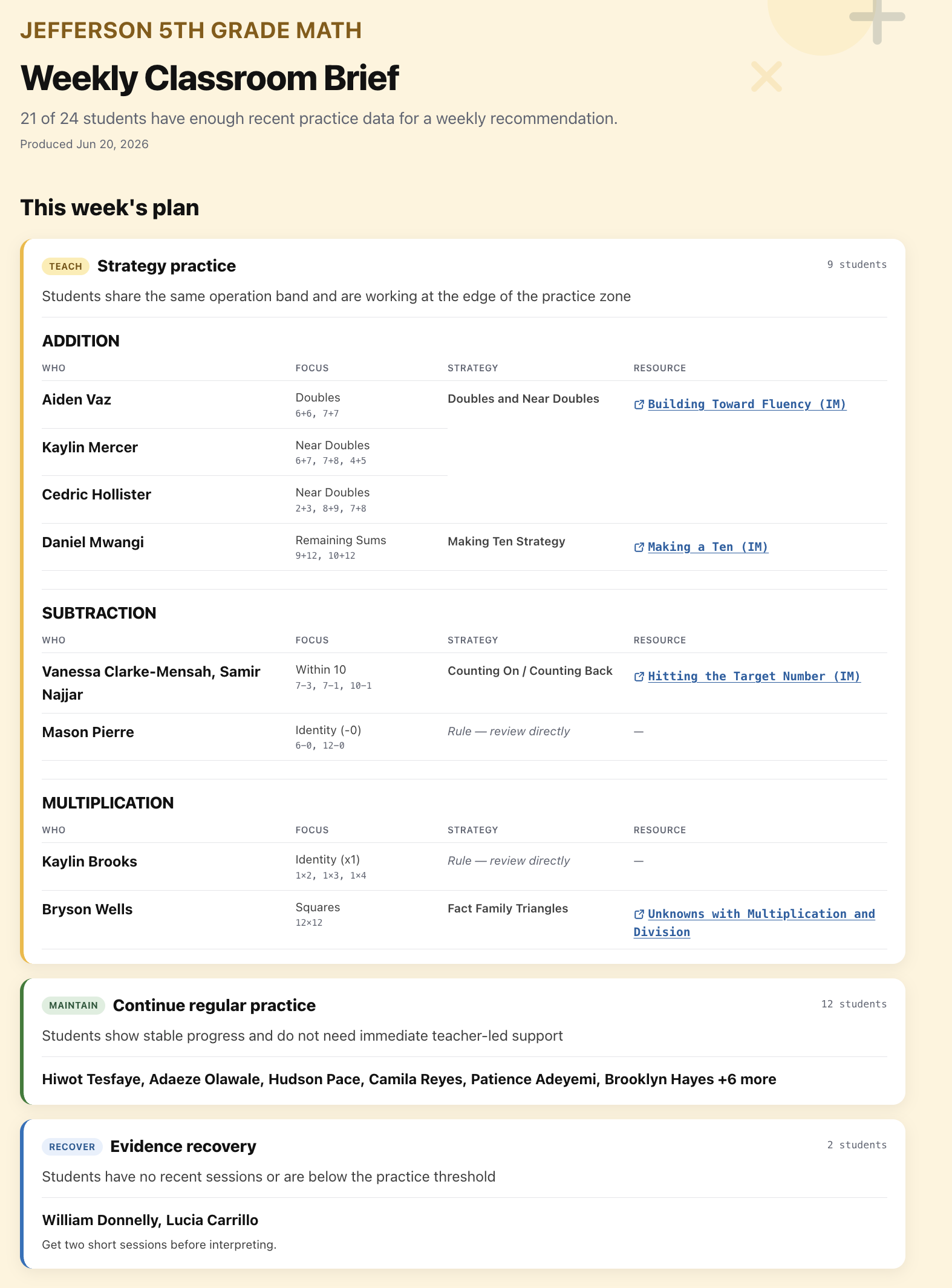
One page, ten minutes, based on your students’ actual recent practice. Here’s a real one, section by section.
-
Students are grouped by the evidence.
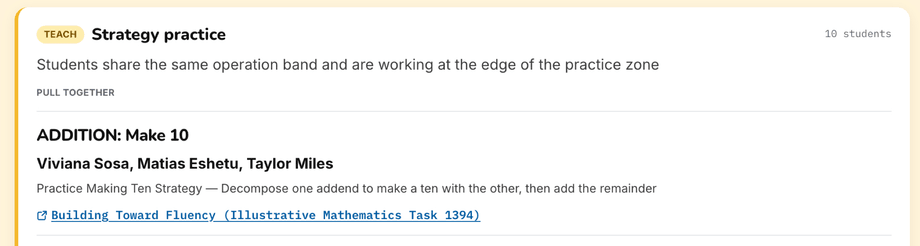
-
Each group gets a research-based strategy — linked to materials.

-
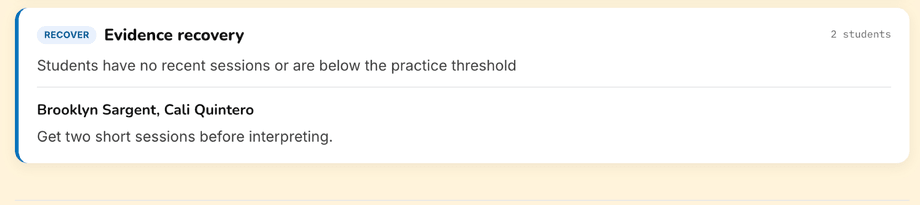
When the evidence is thin, the brief says so.
-
Every student at a glance: mastery, change, and this week’s move.
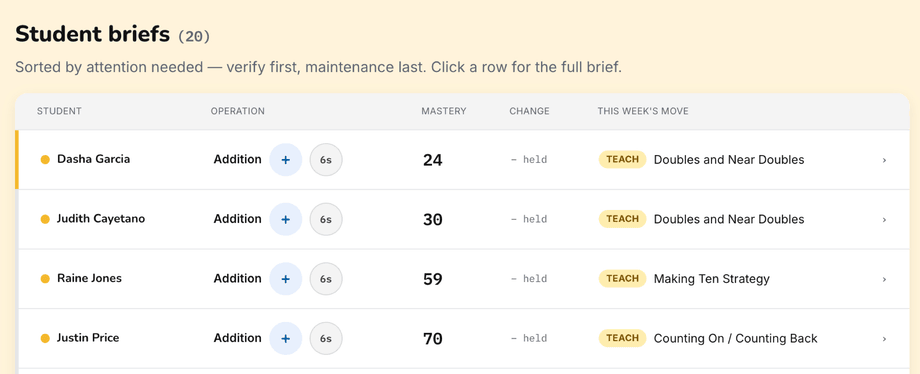
Names are pseudonyms; the brief is otherwise exactly what teachers received.
05 · Governance
Governance by Design.
Every finding is audited before it reaches a teacher for unsupported claims, invented information, and deficit framing. When the evidence is insufficient, the brief says so. The teacher always makes the final decision.
-
No student chat
Fluency Intelligence never talks to children. Analysis happens behind the teacher.
-
No automatic decisions
Recommendations, never prescriptions. Placement and intervention stay with educators.
-
No extra screen time
The same ten-minute routine students already know. No new apps, no new logins.
-
No teacher evaluation
Briefs inform teachers. They are not surveillance and they don’t grade anyone.
Side by side
No chatbot. No black box.
Most AI products put a model between teacher and student. Fluency Intelligence puts AI to work for the teacher by assessing practice and aligning evidence in compliance with district policy.
| AI-first products | Fluency Intelligence |
|---|---|
| Generates more materials | Teachers determine instruction |
| Students interact with AI | Students engage with teacher and peers |
| More content to manage | Content managed automatically |
| Fewer decisions to make | Decisions backed by evidence |
| What's most profitable | What's most important |
| More screen-time for students | Encourages 10-minutes-a-day consistency |
| Requires prompting | Performs recurring tasks |
| Adds workflow | Compresses time and effort |
| Generic AI outputs | Evidence-grounded interpretation |
| Replaces teacher judgment | Respects teacher roles |
- Students do not need another app, another login, or a conversation with an AI tutor.
- Teachers do not need another dashboard to learn or another place to check. They need the action to take, not more data to interpret.
From the classroom
“I have watched my students go from being frustrated and dreading math to being excited to log in to XtraMath!”
Brianna · Classroom teacher
The offer · 2026–27 school year
~$2 per student per year.
The daily practice routine students already know, plus a weekly instructional brief for every teacher. Standard XtraMath stays free — for any teacher, any family, forever.
FAQ